Ans: Fracttal One, Tractian, MaintainX, eMaint, Fiix, IBM Maxima, and UpKeep are some of the best predictive maintenance software for accurately predicting your equipment’s health, thus significantly reducing downtime.
Top 11 Predictive Maintenance Software in 2026
POST BY
PUBLISHED
June 9, 2026
Predictive Maintenance (PdM) is a maintenance strategy that combines the historical maintenance data and predictive technologies, such as IoT sensors, AI, and machine learning, to identify operational anomalies.
A recent study, Predictive Maintenance Market Report 2026-2031 by MarketsandMarkets, highlights that the predictive maintenance market is expected to grow from USD 13.89 billion in 2026 to 23.79 billion by 2031, at a CAGR of 11.4%. Hence, high-stakes industries use PdM for operational and financial efficiency.
With the ever-increasing market and significant benefits, the usage of predictive maintenance software is at an all-time high. This article covers the top 11 PdM software, such as Fiix, Tractian, eMaint, MaintainX, Fracttal One, and more, their benefits, and the factors to consider before opting for one. Follow along to know more:
Table of Contents:
- Best 5 Predictive Maintenance Software for Every Industry in 2026
- Extended List of 6 Best Predictive Maintenance Software for Anticipating Equipment Failure
- What is Predictive Maintenance Software? Key Benefits and Industrial Impacts of a PdM
- Predictive Vs Preventive Vs Reactive Maintenance: Key Differences and Which is Best?
- How to Choose Predictive Maintenance Software? Important Factors and Capabilities
- Wrapping Up!
- Frequently Asked Questions (FAQs)
Best 5 Predictive Maintenance Software for Every Industry in 2026
The top predictive maintenance companies include Tractian, known for its centralised visibility into assets, and Fiix for its detailed and customisable reports and dashboards. Other best PdM software includes Fracttal One, MaintainX, eMain, IBM Maximo, Auguary, UpKeep, and more.
Here’s everything you need to know:
1. Tractian
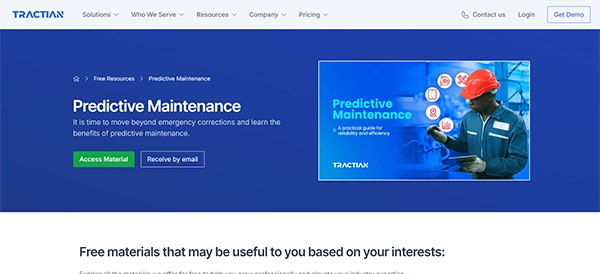
Tractian tops the list of best predictive maintenance software, known for providing real-time visibility into assets’ health by providing a centralised view of the asset condition. The platform is designed to help teams detect failures early and reduce unplanned equipment downtime.
Tractian claims to have helped Whirlpool save over $1 Million with condition monitoring. The standout feature of Tractian is its conditional monitoring, which automatically generates inspection tasks when vibration or temperature exceeds a set threshold.
Best For: Mills and Agriculture, Food and Beverages, Chemicals, Heavy Equipment, Mining and Metals, Oil and Gas, Manufacturing, and the Automotive Industry.
Key Features of Tractian:
- Features smart Asset Performance Management (APM) that analyses trends and performs reliability analysis to monitor asset condition.
- Robust customer support, available 24/7 via email, live chat, or phone.
- Tractian CMMS uses AI to digitise SOP, inspection, and troubleshooting steps with AI-powered checklists, reducing unplanned downtime by 43%.
Downsides to Consider:
- No free trial is available.
- The mobile app can lag occasionally, and offline support is quite limited.
| Pricing Details for CMMS | |
|---|---|
| Standard | $60 per month per user |
| Enterprise | $100 per month per user |
| Bundle | Custom Quote |
2. Fiix
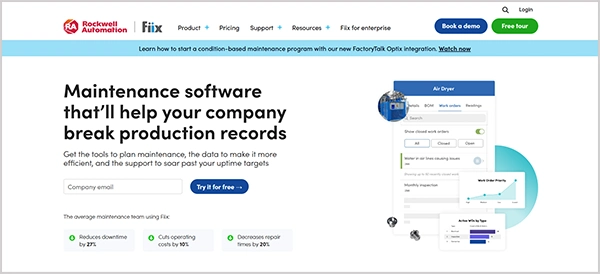
Fiix is one of the best predictive maintenance solutions that offers a centralised approach and offers IoT sensor integrations that help collect real-time data for a predictive maintenance solution. Trusted by the biggest companies worldwide, such as NASA and Siemens, Fiix is known for its robust predictive maintenance module that analyses the usage metrics and maintenance data, along with sensor inputs, to identify potential equipment failures.
Best For: Manufacturing and Production Companies, Energy and Resources, Transportation and Distribution, and Facilities Management Industries
Key Features of Fiix:
- A smart inventory management tool tracks purchase orders and spare part levels, thus reducing downtime caused by missing components.
- Generates detailed failure reports and allows a customizable dashboard to track recurring issues, KPIs, and asset performance.
- Offers cloud-based scalability, allowing access from multiple devices anywhere and real-time collaboration with mobile updates.
Downsides to Consider:
- UI can be cluttered due to many features.
- The mobile app has limited functionality compared to the desktop version.
| Pricing Details | |
|---|---|
| Free | For Limited Users |
| Basic | $45 per user, per month |
| Professional | $75 per user, per month |
| Enterprise | Book a Demo to Get a Custom Quote |
3. MaintainX
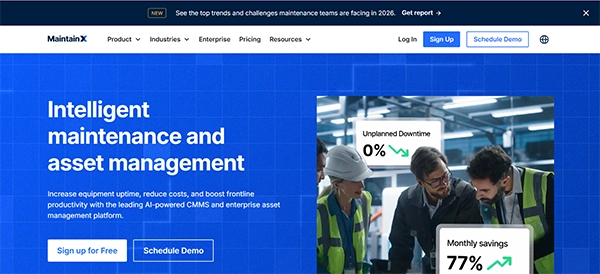
MaintainX is an award-winning AI-powered CMMS software that offers built-in enterprise asset management software to track and analyse assets’ health through their entire lifecycle. The best part about MaintainX is that it provides customizable integrations with major ERP software, such as Oracle, Power BI, SAP, and more, to keep your key systems in sync.
Best For: General Manufacturing, Food and Beverages, Plastics, Automotive, Hospitality, Farming, and Retail Management.
Key Features of Fiix:
- A smart inventory management tool tracks purchase orders and spare part levels, thus reducing downtime caused by missing components.
- Generates detailed failure reports and allows a customizable dashboard to track recurring issues, KPIs, and asset performance.
- Offers cloud-based scalability, allowing access from multiple devices anywhere and real-time collaboration with mobile updates.
Downsides to Consider:
- UI can be cluttered due to many features.
- The mobile app has limited functionality compared to the desktop version.
| Pricing Details | |
|---|---|
| Basic | Free for Small Teams |
| Essential | $20 per user, billed annually $25, billed monthly |
| Premium | $65 per user, billed annually $75, billed monthly |
| Enterprise | Book a Demo to Get a Custom Quote |
4. Fracttal One
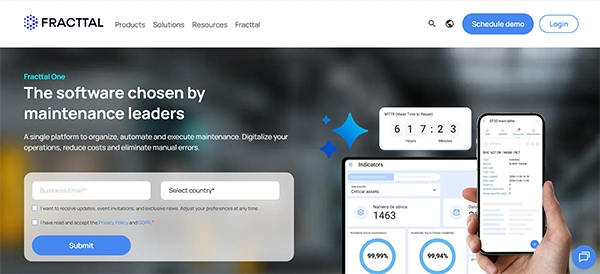
Next on the list of top predictive maintenance software is Fracttal One, known for its excellent forecasting that uses the historical maintenance data to forecast future needs and equipment issues. The standout feature of this predictive maintenance platform is that it facilitates quick records updation and asset identification via bar code and QR scanning features, along with a unified platform that manages assets and operations across multiple sites smoothly.
Best For: Manufacturing, Hospitality, Healthcare, Food, Oil and Gas, and Facility Management
Key Features of Fracttal One:
- Integrates seamlessly with ERP and accounting software for data exchange.
- Ensures robust cost tracking by monitoring expenses, labour costs, and materials, thus facilitating financial insight.
- Sends automated notifications and alerts for critical asset conditions, maintenance requirements, and upcoming tasks.
Downsides to Consider:
- UI can be complex and overwhelming for beginners.
- Limited report customisation.
Pricing Details: Fill out the form available on the website to get a custom quote.
5. eMaint
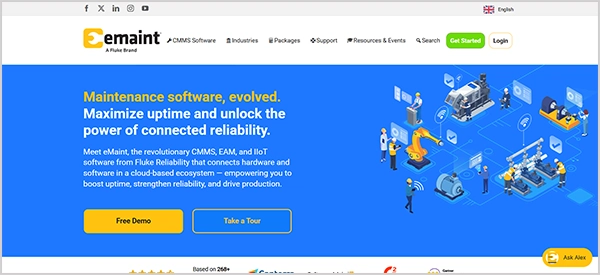
Backed by Fluke and Fortive, eMaint is one of the best predictive maintenance software solutions. Working across 116 countries, with over 3.4 million machines fixed, eMaint enhances the operational uptime by tapping into asset data and sending notifications and alarms to notify potential failure. The best part about this predictive maintenance solution is its flexibility and how everything is tracked with eMaint’s audit trail and e-signatures.
Best For: Life Sciences, Electronics, Healthcare, Packaging Education, Government, Manufacturing, Chemical, Services, and more.
Key Features of eMaint:
- Features a multi-site CMMS that manages the global asset-incentive facilities.
- Generates detailed reports and dashboards that offer visibility into assets’ performance, downtime, and costs.
- Create, assign, and track maintenance tasks in real-time.
Downsides to Consider:
- UI can be complex for beginners.
- Features are limited compared to its competitors.
Pricing Details: The pricing details are not disclosed publicly. Book a demo to get the custom quote.
Extended List of 6 Best Predictive Maintenance Software for Anticipating Equipment Failure
Here’s an extended list of predictive maintenance platforms that you may consider for your business:
| S. No. | Predictive Maintenance Solutions | Key Features | Starting Price |
| 6. | IBM Maximo |
| Custom Quote |
| 7. | Auguary |
| Custom Quote |
| 8. | UpKeep |
| Starts at $24 per month, per user Book a custom quote for professional and enterprise-level services. |
| 9. | GE Vernova |
| Custom Quote Offers a Free Trial |
| 10. | Senseye |
| Starts at $7.50 per user, per month |
| 11. | ABB |
| Custom Quote |
What is Predictive Maintenance Software? Key Benefits and Industrial Impacts of a PdM
The National Maintenance Authority defines predictive maintenance software as “condition-based maintenance (CBM) in which the timing of maintenance actions is determined by the observed condition of an asset and a probabilistic forecast of its remaining useful life (RUL)”.
In simpler words, a PdM is a maintenance strategy that uses the historical and current data to predict an asset’s health and future anomalies. It uses IoT sensors, AI, and machine learning for forecasting, so the teams can fix the problems before a complete and unpredictable breakdown or failure.
For instance, a manufacturing plant can use sensors on motors to assess its temperature and vibrations. In case of abnormalities, maintenance can be scheduled before the motor fails.
Benefits of Using Predictive Maintenance Software: Financial and Operational Efficiency
By extending the equipment lifetime, lowering the maintenance cost, improving operational efficiency and workplace safety, and offering real-time visibility, predictive maintenance applications provide multiple benefits.
Here are some financial and operational benefits of PdM:
- Lower Maintenance Cost: By significantly reducing the equipment downtime and frequent failures, predictive maintenance software can lower the maintenance costs and boost the overall productivity. Not only does it reduce the maintenance cost, but it also reduces the labour cost by automating the maintenance process.
- Extended Equipment Lifetime: According to the Bureau of Economic Analysis, the average service life of private nonresidential equipment is 16 years, highlighting how long-term asset reliability is crucial for businesses. A PdM helps organisations maximise the lifespan by early anomaly detection and preventing mechanical failures that reduce the lifespan, hence enabling companies to operate ageing assets safely.
- Improved Operational Efficiency: By prioritising the asset’s maintenance needs and identifying issues early, a predictive maintenance platform enhances operational efficiency. It analyses the historical maintenance and current data to predict future failures, reducing unplanned downtime.
- Enhances Workplace Safety: Unpredictable equipment failures can create safety hazards, increasing the chances of injuries and accidents. By identifying and addressing the safety risks before the equipment becomes hazardous, predictive maintenance software reduces workplace accidents and improves compliance with safety standards.
- Real-Time Equipment Visibility: By offering continuous insights into the asset’s health and operational performance, a PdM ensures real-time equipment visibility using dashboards and mobile apps. The teams can get timely alerts and notifications, health scores, and performance analytics remotely, increasing responsiveness and productivity.
Predictive Vs Preventive Vs Reactive Maintenance: Key Differences and Which is Best?
To manage equipment health, modern industries use three common maintenance approaches: predictive, preventive, and reactive. These three differ from each other in terms of their workings, suitability, downtime, technology used, and equipment lifespan.
Here’s everything you need to know about the key distinction between the three:
| Point of Difference | Predictive Maintenance | Reactive Maintenance | Preventive Maintenance |
| How it Works | When IoT sensors or AI algorithms detect anomalies. | The machine operates until failure, and maintenance is done after a breakdown. | Maintenance and inspections occur periodically. |
| Advantage | Cost efficiency and extended equipment lifespan. | Simple maintenance and initial cost are low. | Regular checks and reduced failure frequency. |
| Disadvantage | High investment and skilled workforce requirements. | High downtime risk and expensive emergency repairs. | Limited insights and unnecessary maintenance costs. |
| Technology Required | High: IoT sensors, machine learning, CMMS, and AI | None | Medium: CMMS and scheduling tools. |
| Downtime Type | None | High: extremely unpredictable | Medium: planned downtime |
| Suitable For | High-risk businesses and industries | Non-critical and low-cost equipments | Moderately critical equipments |
| Equipment Lifespan | Maximum | Shorter due to multiple frequent failures. | Improved |
Which is Best? Predictive, Preventive or Reactive Maintenance?
Predictive maintenance software is generally considered the best maintenance strategy for overall business growth. It significantly reduces downtime and maintenance costs while extending the equipment’s lifespan through real-time monitoring and advanced technologies such as IoT sensors, CMMS, and machine learning.
Here’s why predictive maintenance software is the best:
- Ensures Highest Long-Term Savings
- Lowest Downtime
- Extended Equipment Health
- Real-Time Monitoring
- Proactive Maintenance Approach
Important Note:
The “best approach” also depends on the business and equipment types, operational, and budget.
- Select the reactive model if the equipment is non-critical and the business faces budget constraints.
- A preventive model works well when medium-priority equipment is taken into consideration.
How to Choose Predictive Maintenance Software? Important Factors and Capabilities
Real-time asset monitoring, budget considerations, ERP software integrations, failure prediction analysis, mobile maintenance app, and customisable reporting and dashboards are among the key capabilities a PdM must possess to enhance operational efficiency.
A recent study by Siemens, The True Cost of Downtime 2024, highlights that unplanned downtime now costs the world’s 500 biggest companies $2.8 billion every year, which is 11% of their revenue. Hence, it becomes crucial for companies to invest in the right PdM software.
Here’s everything you need to know:
- Real-Time Asset Monitoring: The primary role of any predictive maintenance software is to perform real-time asset monitoring and continuously track equipment’s health using IoT sensors and AI systems.
The software should monitor parameters such as temperature, pressure, vibration, voltage, and oil quality, and subsequently send alerts or notifications in case of an anomaly.
- Integration with Existing Systems: The potential PdM must integrate smoothly with ERP software, CMMS, and IoT sensors. It enables real-time monitoring, centralises the maintenance operation, simplifies asset tracking, and automates work orders.
- Failure Prediction Analytics: By using the historical maintenance and real-time data, AI models of PdM must be able to predict future equipment failure, asset degradation or remaining useful life (RUL). This presents unpredictable catastrophic failures, reduces repair cost, and enhances operational reliability.
- Mobile Maintenance App: A functional mobile application allows teams to get alerts and notifications instantly and monitor the equipment remotely. Hence, select a PdM that enables centralised and real-time communication and enhances responsiveness and productivity.
- Budget Considerations: The initial set-up cost of predictive maintenance software can be expensive. Prepare a comprehensive budget outline that anticipates all the expenses and ROI. Fiix and Maintainx are great options, as they offer a free trial for limited users.
- Customisable Reports and Dashboards: A PdM dashboard and report must provide insight into the asset’s health, KPIs, failure frequency, downtime statistics, trends and performances. The simple visualisation enhances decision-making and supports data-driven maintenance.
Suggested Reading: 10 Best CRM Software – Features, Pros & Cons (2026)
Wrapping Up!
To conclude, the predictive maintenance market is growing rapidly with multiple high-stakes companies, such as manufacturing, oil and gas, chemicals, plastics, automotives, and more, adopting it for enhanced operational efficiency. With multiple benefits, like reduced costs and downtimes, high ROI, and workplace safety, predictive management software is one of the best approaches that helps businesses succeed in the economy.
Frequently Asked Questions (FAQs)
Q1: What are some of the best predictive maintenance platforms for maintaining equipment health in 2026?
Q2: What are the industries that use predictive maintenance software?
Ans: Manufacturing, Oil and Gas, Automotive, Chemicals, Food and Beverages, Healthcare, Hospitality, Mining, Logistics and Warehousing are some of the popular industries that use predictive maintenance solutions.
Q3: Is predictive maintenance software expensive?
Ans: Yes, initial implementation for predictive maintenance platforms can be expensive as it includes setting up IoT sensors, AI technology, and system integrations. However, this software is known to deliver high ROI by reducing downtime, equipment failures, repairs, and increasing equipment lifespan.
Q4: Which one is better among predictive, preventive, and reactive maintenance?
Ans: Predictive maintenance systems are best for overall business growth when compared to the other options, as it significantly lowers the maintenance cost and equipment failures. However, the best approach also depends on the business size, financial constraints, asset type, and operational risk.
Q5: What are the benefits of using a predictive maintenance solution?
Ans: Low maintenance cost, improved operational efficiency, equipment lifespan, and workplace safety are among the benefits of using predictive maintenance applications.
Q6: Can small businesses and companies use predictive maintenance platforms?
Ans: Yes, small and growing enterprises or businesses can use cloud-based predictive service maintenance software, available at affordable subscription prices. The best software for growing companies includes Fiix, Traction, UpKeep, and more.
Sources:
Predictive Maintenance Industry Reference: Scope and Standards – National Maintenance Authority