Ans: The tool handles all the workplace operations of a business, allowing it to track assets, manage space, and oversee tasks to reduce downtime and improve productivity.
Top 10 Facility Management Software For Smarter and Seamless Operations
POST BY
PUBLISHED
May 28, 2026

Facility Management (FM) software is a centralized digital tool that helps businesses to track assets, optimize building operations, and automate maintenance on a single, designated platform.
Accordingly, this tool simplifies complex facility tasks by enhancing operational efficiency, reducing downtime, and streamlining day-to-day workflows across commercial spaces.
Therefore, if you wish to know more, read this article thoroughly to discover its types and benefits, along with the list of the top 10 facilities management software that are currently leading the work marketplace.
Table of Contents:
- What are the Different Types of Facility Management Software?
- What are the Top 10 Leading Facility Management Software?
- Who Uses Facilities Management Software?
- What are the Benefits of the Facility Management Software?
- What are the Things You Must Consider Before Using Facility Management Software?
- Bottom Line
- Frequently Asked Questions
What are the Different Types of Facility Management Software?
There are five different types of facility management system software, including BMS, EAM, IWMS, CAFM, and CMMS. Below, we have mentioned them individually; take a look.
- Building Management Systems: BMS is a computer-based system that helps organizations automate, monitor, and optimize a building’s technical and electrical operations. For instance, power systems, security, and HVAC.
- Enterprise Asset Management: EAM is a comprehensive software system that operates to manage the entire lifecycle of the company’s physical assets, from purchase/manufacture to disposal.
- Integrated Workplace Management Systems: IWMS software is responsible to centralized and optimizing the organization’s space, assets, real estate, sustainability, and workplace services, all in one platform.
- Computer-Aided Facility Management: The key purpose of CAFM software is to optimize maintenance management, track physical assets, automate work orders, and ensure regulatory compliance.
- Computerized Maintenance Management Systems: Primarily focus on maintenance operations, the CMMS software manages asset & inventory while enhancing preventive scheduling to significantly reduce downtime and extend overall acquisition lifetime.
What are the Top 10 Leading Facility Management Software?
There are numerous options available on the internet to manage assets; however, not all of them can be reliable. In this section, we have listed the 10 best facility management software currently leading the industrial market.
Let’s check them out.
1. FMX Facilities Management Software
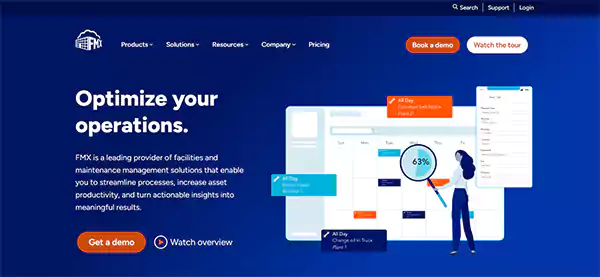
FMX is one of the prominent software programs that provides a reliable interface for maintenance and management solutions. It helps businesses to streamline their work operations, enhance asset lifespan, and allow the team to turn actionable insights into productive and beneficial outcomes.
Key Features:
- Provides a centralized space where each team member can coordinate and collaborate to work on tasks productively.
- The tool organises and optimizes a business’s data performance so that you can get informed promptly about your assets and investments.
- Configure the approval processes and request process to take control of your scheduling process and align with your company workflow.
| Benefits | Drawbacks |
| Delivers robust scalability and flexibility to adapt to your future shifts. | A little bit expensive for small-scale companies. |
| Features a dedicated space for team collaboration, eliminating the use of emails and meetings via different platforms. | |
| Perform robust asset tracking, reducing casualties. |
2. Archibus by Eptura
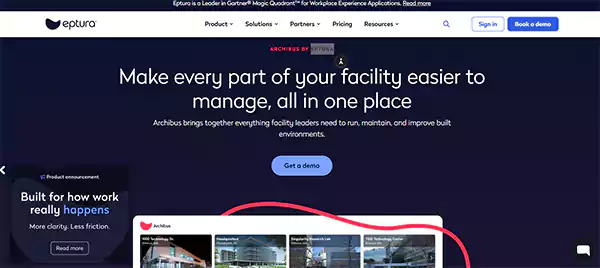
Ranked among the Integrated Workplace Management Systems (IWMS), the Archibus by Eptura facility management tool makes every aspect of your maintenance easy and effective. Moreover, this tool also serves as an asset management software, delivering robust tracking and cost-effective solutions for businesses.
Key Features:
- Allows companies to save their data securely and ensure proper compliance with audit, preventing possible future liabilities.
- Create clear and measured analytics reports, helping teams to make more precise decisions with accurate stats.
- Provide an API access to the developer and allow them to integrate with the external tools.
| Benefits | Drawbacks |
| Offer a comprehensive module covering space planning, maintenance, real estate, and entire asset management. | Often, businesses find the tool interface complex and difficult to use, requiring high training. |
| Integrate BIM and GIS to provide an accurate and efficient visual management of assets. | |
| Best for a large organization that requires complex and highly regulated facility conditions. |
3. Service Channel
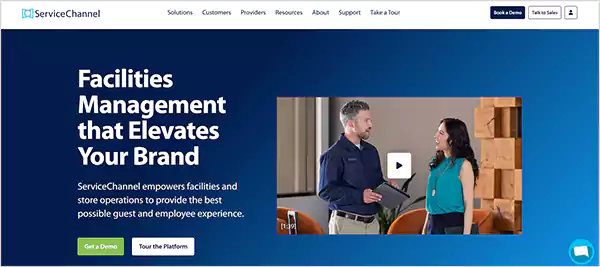
ServiceChannel is a cloud-based facility management software, known for its robust computerized maintenance management systems (CMMS) and enterprise asset management (EAM) functionality. Trusted by 600+ brands, this tool is primarily designed for a multi-site enterprise that empowers them to manage repair, building maintenance, and asset operations.
Key Features:
- From creation to approval, the tool automates the entire maintenance process request.
- It helps businesses to contact multiple service providers, ensuring they have the required license and insurance.
- Track the lifespan of the asset to prioritize preventive repair over replacement.
| Benefits | Drawbacks |
| Provides a centralized space for managing and maintenance tasks on one platform, improving visibility and accountability. | Often, the tool interface lacks while making a report or refreshing the page for new updates. |
| Provides GPS check-in and real-time tracking for the team, and clear communication with vendors. | |
| Automate the invoice process to streamline the financial data, ensuring complete compliance. |
4. Facilio Facility Management Software
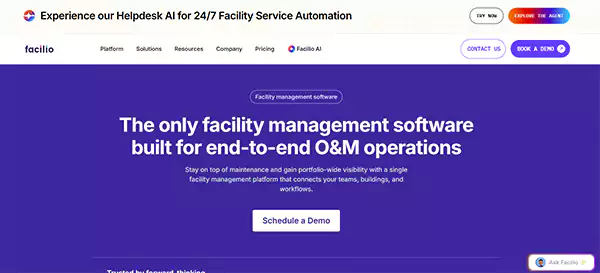
Facilo is an AI-driven and IoT-enabled enterprise platform that is specially designed to handle comprehensive facility and building operations of any sort of business.
From work order and service request management to generating data-driven reports, this tool serves as a Computer-Aided Facility Management (CAFM) and Computerized Maintenance Management System (CMMS) solution.
Key Features:
- Employs AI agents for predictive maintenance, automating service requests, and invoice verification.
- Seamlessly connects businesses with ERP, IoT devices, and Building Management Systems (BMS) to provide accurate, data-driven reports.
- Provide a specified tenant app to submit maintenance track along with the tracking request status.
| Benefits | Drawbacks |
| Offer an intuitive interface with a highly customizable dashboard. | The tool pricing seems quite high, compared to its competitors. |
| Robust customer support team. | |
| Timely analysis and optimising data to provide a data-driven report for better decision making, reducing downtime by 40%. |
5. Maintain X
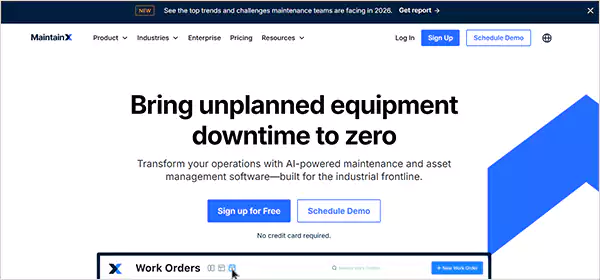
Moving ahead, Maintain X is another top-rated, mobile-first facility management software. Specialized in Computerized Maintenance Management System (CMMS) functionality, this tool streamlines asset management, maintenance operations, and other work tasks for the frontline team.
Moreover, with the user-friendly interface, this tool instantly adapts to business shifts, ensuring seamless visibility and accountability.
Key Features:
- Maintain X employs several AI features to transcribe a voice note into a work request, identify an asset, and even generate a procedure from photos.
- Create, assign, and track work requests with real-time updates.
- Provides a space dedicated to team collaboration, so that technicians can connect anytime, anywhere.
| Benefits | Drawbacks |
| Delivers an intuitive, modern design interface, reducing training or learning time for the team members. | Often lacks in providing in-depth reporting. |
| Provide an excellent mobile app, allowing instant work operation and a smooth photo upload procedure. | |
| Features in-app messaging and commenting on work orders for better updates and task performance. |
6. Brightly A Siemens Company
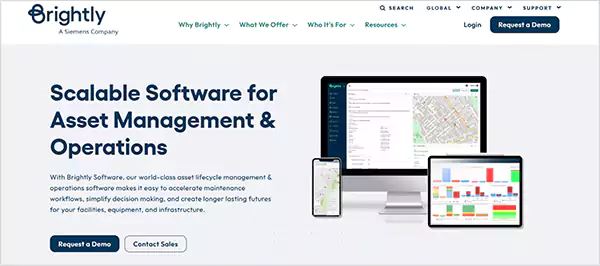
Brightly is one of the top-rated, cloud-based tools acquired by Siemens in 2022, specializing in digital building operations and infrastructure management. Notably, this tool has served 11,000+, including healthcare, education, and commercial sectors.
Moreover, Brightly’s core offering includes solutions of Enterprise Asset Management (EAM), Computerized Maintenance Management Systems (CMMS), and IoT-driven insights.
Key Features:
- Streamline work orders and task management, allowing managers to assign and track maintenance requests from a central location.
- Prioritize planned, proactive maintenance over reactive repairs to reduce downtime and significantly increase asset lifespan.
- Integrates the tool with the IoT technology to track and monitor asset health to alert the team about maintenance in real-time.
| Benefits | Drawbacks |
| Streamlines work management by easy submission and assignment of work orders for field agents. | Advanced customization options seem a bit complex to manage and operate. |
| Best for managing assets from multiple facilities on a single, designated platform. | |
| Delivers robust scheduling, tracking, and automating preventative maintenance. |
7. IBM Maximo Application Suite
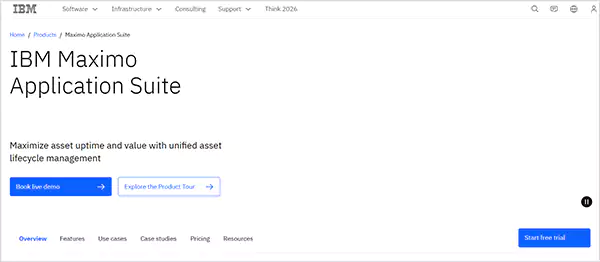
IBM (MAS) is a leading, comprehensive, and AI-driven software that is especially designed for enterprise asset management (EAM), reliability, and maintenance to evolve and combine multiple operations in a single platform.
It integrates asset performance management, reliability-centered maintenance, and EAM, allowing a smooth and effective workflow without navigating to multiple tools.
Key Features:
- The IBM Maximo Application Suite provides comprehensive inventory control, work management, and procurement.
- Track, monitor, and record the entire lifespan of the asset, from purchase/manufacture to disposal/sale.
- Employ an AI-driven agent to manage and make analytical reports, aiming to reduce downtime.
| Benefits | Drawbacks |
| Delivers robust flexibility, instantly adapting to specific industry workflow and processes. | The tool’s initial configuration is a bit complex and difficult to understand, and often requires special technical training. |
| Use IoT and AI to prevent and reduce failures rather than just reacting or reporting to them. | |
| Offers robust device compatibility. |
8. Fiix Facilities Management
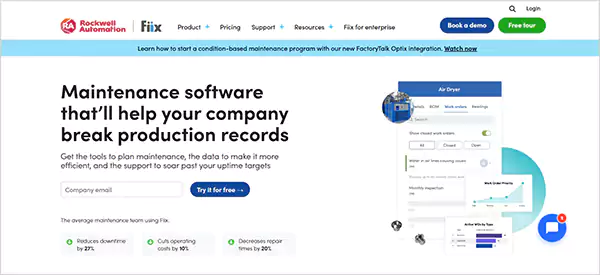
Fiix is a prominent AI-powered, cloud-based computerized maintenance management system (CMMS) that empowers organizations to streamline their facility operations by managing inventory, tracking assets, and automating work orders.
Notably, with its special AI features and an intuitive interface, the tool ensures a smooth and effective facility management, reducing organization downtime by 27%.
Key Features:
- The Fiix tool creates, assigns, and prioritises work requests and maintenance faster by 78%.
- Empowers technicians to update work orders, manage tasks, and scan barcodes on-site, even without an internet connection, for easy workflow.
- Connect the tool with the building automation systems (BAS) and ERP for seamless data flow.
| Benefits | Drawbacks |
| Offer a user-friendly and easy-to-navigate interface. | Customizing reports can be difficult and time-consuming. |
| Delivers robust mobile applications to capture photos, scan barcodes, and close work orders in real-time. | |
| Provides strong assets and inventory tracking. |
9. UpKeep Facility Management Software
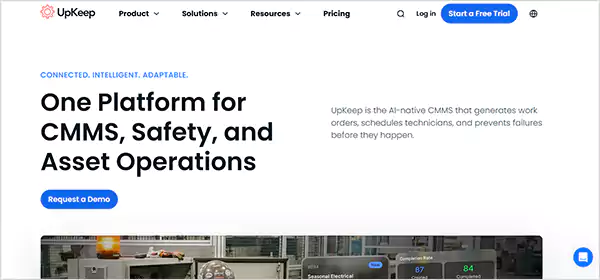
Trusted by 4000+ organizations, the UpKeep facility management software is one of the top-rated, mobile-first CMMS solutions that is specifically designed to streamline maintenance and asset tracking operations.
Furthermore, the tool comes with both a premium and a free version, delivering robust features for efficient maintenance management of all size organzation.
Key Features:
- Technicians can receive, update, and track work orders directly on their phones without any mistakes.
- Automate maintenance tasks to reduce the downtime percentage while fostering an overall asset lifespan.
- Generate a real-time report to monitor and optimize KPIs and acquire insights into team performance.
| Benefits | Drawbacks |
| Features a user-friendly interface, enabling minimal training and quick adaptation. | Often, minor bugs or screen lag problems may occur during peak hours. |
| Delivers top-tier mobile applications. | |
| Provide a free account for users who only use the tool to submit work requests. |
10 Accruent Maintenance Mgmt Software
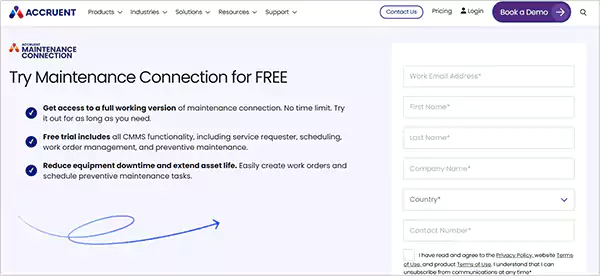
Accruent Maintenance Mgmt Software is a top-rated, robust CMMS/EAM solution, including essential components like thorough asset management, preventative maintenance scheduling, and mobile accessibility for technicians.
Remarkably, the tool provides inventory tracking, real-time operational insights, advanced reporting, and compliance management, enhancing workflow productivity and optimizing maintenance workflow across multiple facilities and assets constructively.
Key Features:
- The tool generates automatic audit logs and systematically keeps records of maintenance tasks for regulatory compliance with audits.
- Provides a mobile application (MC Kinetic), allowing organizations to access, update, and submit work orders even in offline mode.
- From assignment and creation to completion, the tool streamlines the entire work order management process.
| Benefits | Drawbacks |
| Provide detailed tracking of asset history, specification, and warranties. | Uploading documents can be difficult and time-consuming. |
| Streamline comprehensive work management, from request to completion. | |
| Automates scheduling operations to reduce downtime and enhance asset longevity. |
Read More: Top 25 Powerful Event Management Software for Seamless Event Execution
Who Uses Facilities Management Software?
The facility management system software supports the team that is responsible for supervising the building operations, asset tracking, maintenance, and workplace management. For instance,
- The facility management team in a commercial building uses the facility management system to handle day-to-day operations and maintain the workspace.
- Schools and universities equip this tool to manage their classrooms and campus activities, managing every single operation on a single platform.
- Manufacturing companies use the facilities management system to track & maintain assets, reduce downtime, and perform safety inspections.
- Real estate incorporates this tool to track their tenant services, leases, and property maintenance operations.
- With the facility management software, government offices manage public infrastructure and work orders efficiently.
Also Read: Top 10 Compliance Audit Software: Updated Picks of 2026
What are the Benefits of the Facility Management Software?
The facilities management software significantly improves efficiency by automating maintenance, reducing costs, tracking assets, enhancing safety, and streamlining workplace operations.
Moreover, here are some additional values that the best facility management software adds to your business. Check them out.
- Enhance Productivity and Efficiency: Companies streamline the routine tasks and automates it overall workflow to reduce manual work and encourage more accurate collaboration for the team.
- Foster Asset Management: Maximize the lifespan of the business’s equipment by ensuring proper, proactive maintenance, reducing downtime, and inventory losses.
- Significant Cost Saving: With the software facility management, organizations can accurately optimize inventory stock to avoid overstocking and associated casualties. Also, the tool helps to lower the expenses through preventative measures, allowing the company to save a notable amount annually.
- Better Communication and Workflow: Centralize all sorts of maintenance requests and work orders at a single platform for better tracking and collaboration, even within large-scale teams.
- Improved Compliance and Safety: The facility software management ensures that the business complies with all safety regulations and compliance audits on time, preventing penalties and liability risk.
Notably, according to Fortune Business Insight, globally, the facility management market is projected to reach USD 2,284.8 billion by 2032, highlighting the growing demand for smart facility management solutions.
What are the Things You Must Consider Before Using Facility Management Software?
Before opting for any facility management app for your business, it is important to focus on some crucial factors, so that you can find your perfect match that aligns with your requirements effectively.
Below, we have mentioned these factors for you; let’s check them out.
- Be Specific About Your Requirements: Identify your business’s core challenges and operations (such as energy efficiency, space management, or an asset tracker) that need to be automated and managed.
- Flexibility and Scalability: Avoid a rigid facilities management app. Choose a tool that grows with your business and constantly adapts to future conditions.
- Simple Use and Implementation: The tool interface should be easy to navigate and simple, so that your team can operate it hassle-free and conveniently.
- Regularize Data Input: The tool must have a proper space for the asset data, work records, and compliance documentation, and functions of vendor management software, ensuring accurate reporting and timely audit obedience.
- Robust Device Compatibility: Look for a tool that supports both the laptop and a mobile screen, allowing your team member to manage task & work orders, anytime, anywhere.
- Prioritize Profitable Return on Investment: The facility management software must estimate the total cost, including every expense, license fees, and implementation charges, ensuring a high ROI.
Read More: SaaS Vs Cloud: Which is Better for Your Business in 2026?
Bottom Line
In a nutshell, the best facility management software is strategically designed to simplify complex work operations, improve maintenance planning, and enhance overall workplace efficiency for businesses of all sizes. Accordingly, it helps in better asset tracking and team collaboration, allowing the organization to save time, reduce maintenance costs, and eventually boost efficiency.
Thus, what are you waiting for? Opt for any one of the mentioned facilities management software in this article for your business and transform your daily operations into smoother and more productive ones now!
Frequently Asked Questions
Q: What do facilities management tools do?
Q: What are the different types of software facility management?
Ans: There are five different types of FM software, such as building management software (BMS), enterprise asset management (EAM), integrated workplace management systems (IWMS), computer-aided facility management (CAFM), and computerized maintenance management systems (CMMS).
Q: What are the 3 best CMMS facility management platforms?
Ans: FMX Facility Management Software, Maintain X, and IBM Maximo Application Suite are the three best CMMS tools, currently leading the marketplace.
Q: What are the four crucial pillars of facility management software?
Ans: People, Processes, Building, and Technology are the four main components of the FM software that form a foundation for a safe and productive work environment.
Q: Can a facility management platform be used for a small-scale company?
Ans: Yes, any team that is responsible for building maintenance, tracking assets, and streamlining day-to-day work operations can employ the FM software. It helps to reduce their manual work and get tasks done with more accuracy, regardless of the company’s size.
Sources:
Facility Management Software: Forbes