There is no one-size-fits-all sales forecasting solution. However, quantitative forecasting with reliable software is found to be the best method. The software collects historical data and provides a close probability rather than relying on human calculations.
20 Best Sales Forecasting Software to Improve Revenue Planning in 2026
POST BY
PUBLISHED
July 8, 2026

Sales forecasting software is a business application that helps organizations estimate future revenue by forecasting which deals are most likely to close within a specified period. It is not just helpful; it’s essential for effective decision-making for modern businesses. This program analyses your pipeline data, previous deals, and buyer behavior to provide an accurate sales forecast.
If you want to know the right sales forecasting tool for your business, read this article that includes the 20 best sales forecasting tools. It will also help you understand different types of this software and the benefits of using it.
Table of Contents:
What is the Sales Forecasting Software?
As the name suggests, Sales forecast software is a time-saving tool to predict future revenue and demand. It uses historical data, pipeline progression, and AI algorithms to provide a close estimate. This system replaces the spreadsheet formula with data-driven insights to track performance and manage risks more efficiently.
Best 10 Sales Forecast Software
The top revenue forecast software should have all the necessary features to help the team predict sales and assess performance accurately. Some of the best ones are Aviso, Clari, Anaplan, and Weflow, which can make sales planning easy and hit revenue consistently. Here is the list of the top 10 sales forecast tools:
1. Aviso
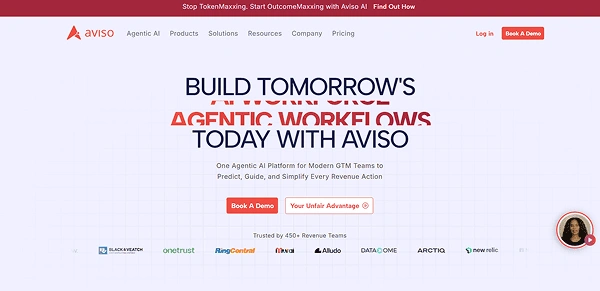
Aviso is a famous AI sales forecasting software that promises 98% forecast accuracy. This program follows the unified forecasting approach, combining human judgment with the advanced AI forecasting feature. It is helpful for decision-making as it facilitates an easier pipeline and deal management.
- Best for: Revenue teams
- Pricing Details: Operates on the custom price model. A free trial is available for 30 days.
Key Features:
- Time-Series Deal Tracking: It does not evaluate only the static snapshots but preserves the whole history of the deals. In this way, it tracks every event to provide great outcomes.
- Winscore Insights: It has an AI scoring system that provides the probability percentage of whether the deals will or will not close. This also offers the reasoning behind each prediction.
- Conversational Intelligence: The system automatically logs communications through emails, calendar, and call transcripts. It analyses them to understand the buyer sentiment and their true intent.
Limitations:
- CRM Capabilities: The system does not come with CRM capabilities. If you don’t have the CRM already, you may face alignment issues with this program.
- Slow Performance: Users report that there are slow loading times and frequent system lags that can affect the accuracy of the forecasting.
2. Clari
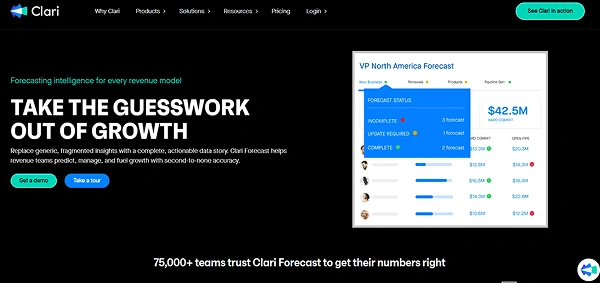
Clari, as its name suggests, focuses on the clear and precise predictions of revenue in simple formats. It is the best forecasting software for pipeline visibility and revenue governance. You can get the every quarter update on revenue health indicators and changes in the forecast.
- Best for: B2B sales teams
- Pricing Details: Operates on quote-based pricing; a free demo is available on request.
Key Features:
- Predictive Forecasting: Features multidimensional roll-ups with categories like best case, commit, upside, and pipeline that help predict the close probability.
- Pipeline Inspection: This system facilitates real-time visibility to identify risky or high-probability deals. It allows the leaders to track pipeline movement week over week.
- Historical Trend Analysis: Visualizes the quarter-over-quarter and historical trends. This helps businesses identify what is actually trending compared to the previous periods.
- Copilot CI: It has the conversational intelligence module that was previously known as Wingman. This has call recording and deal intelligence.
Limitations:
- Steep Learning Curve: Users report that the platform interface is not intuitive. It takes weeks for the new users to learn to use it.
3. Anaplan
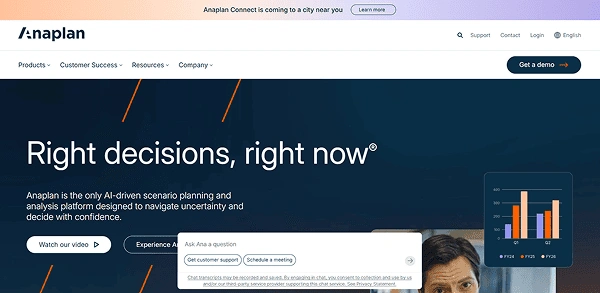
Anaplan is the sales forecasting & analytics software that helps maintain more control over business performance. It is an all-in-one finance and supply solution for quickly scaling businesses, integrating forecasting with the broader company planning. This platform is well-regarded for its adaptability, as it allows users to build reports on the existing spreadsheet model.
- Best for: HR teams
- Pricing Details: Cost is custom quoted; free trial available for 90 days.
Key Features:
- Multi-Dimensional Modelling: Provides forecasts that connect sales, finance, HR, and operations. In this way, it provides a collaborative picture of the performance, facilitating better growth planning.
- Pipeline Tracking: This system monitors the week-over-week changes. This helps managers to identify risky deals and deliver data-driven coaching.
- Scenario Planning: Provides real-time scenario planning to understand the impact of market changes and deal restructuring on revenue targets and what-if scenarios across products and business units.
Limitations:
- Requires Technical Expertise: This software’s highly customized model demands dedicated admins.
- Too Complex for Simple Use Cases: It is not suited for smaller operations. The platform’s architecture and massive volume formula can be overkill for them.
4. Salesforce
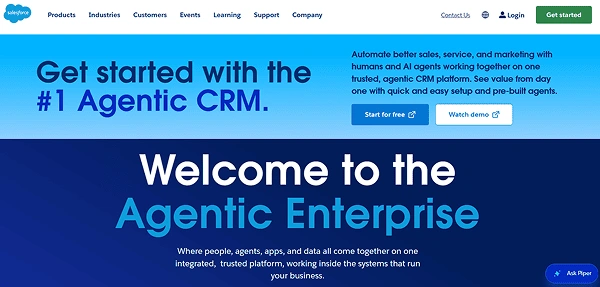
Salesforce is the forecasting sales software for larger enterprises that have complex business operations. It is a technology suite that includes products for sales, marketing, and customer service. This retail forecasting software is built into a sales tool named Sales Cloud. It is the best CRM software that provides effective pipeline management and forecasting solutions to users.
- Best for: Large enterprises
- Pricing Details: $25 per user/month (Essentials), $75 per user/month (Professional), $150 per user/month (Enterprise), $300 per user/month (Unlimited). A 30-day free trial is available.
Key Features:
- Einstein Forecasting: It has a predictive model with which it aggregates the individual deal predictions across the organisation. This helps in generating bottom-up close forecasts.
- Opportunity Scoring: This has the AI-assisted scoring system. In this, it provides scores from 1-99 based on the historical win and loss patterns.
- Segment and Territory Forecasting: Allows the sales leaders to roll up the revenue and quota numbers based on different business dimensions. The user can filter forecasts by geography, industry, and customer segments.
Limitations:
- High Cost and Complexity: The premium features are relatively expensive. Implementation often takes months and requires specialized developer expertise.
5. Weflow
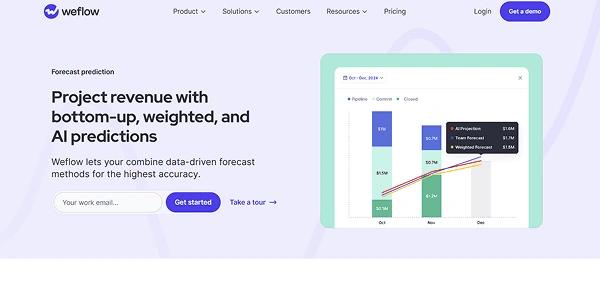
Weflow is the forecasting tool that helps streamline the complex sales processes and provide close forecasting. This system is designed to improve the efficiency of the sales team who use the Salesforce CRM. It is a great time-saving tool that automates repetitive tasks so that the team can focus on other significant sales activities.
- Best for: CRM heavy companies
- Pricing Details: $39 per user/month (foundational forecasting), $49 to $74 per user/month (pro plans). A 14-day free trial is available.
Key Features:
- Workflow Automation: automates various sales tasks to save time and reduce errors, increasing the productivity of the team.
- Accurate Forecasting: This platform analyzes the historical data and pipeline to provide reliable forecasting.
- Custom Dashboards: help users to track key metrics with custom dashboards with filters by rep, team, and record type.
Limitations:
- Salesforce Dependency: requires Salesforce as the core CRM, making it less suited for teams that are using other CRM platforms.
6. Pipedrive
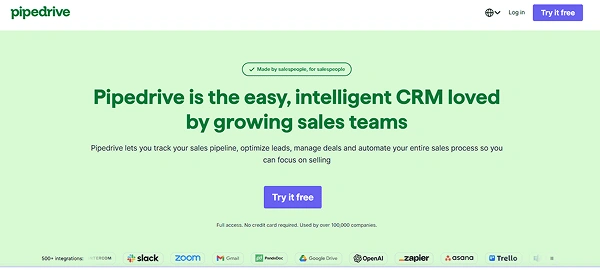
Pipedrive has forecasting functions that are like having a personal sales manager. This is one of the best forecasting software tools that provides visual pipeline management. It also has a customizable forecast view that users can check from time to time for efficient planning and faster course correction.
- Best for: Small sales teams
- Pricing Details: $14.90 per user/month (Essential), $24.90 per user/month (Advanced), $49.90 per user/month (Professional), $99 per user/month (Enterprise), Free demo is available on request.
Key Features:
- Visual Pipeline and Deal Management: It has drag-and-drop boards that provide real-time visibility into sales progress and deal values.
- Mobile Accessibility: This platform has mobile apps for Android and iOS with extensive features like voice notes and automatic call logging.
- AI Sales Assistant: Its AI assistant helps you analyze your performance and provide improvement tips.
Limitations:
- Limited Collaboration and Customization: It is found not ideal for large and cross-functional teams. This lacks the shared view for account management and has restrictions on advanced filtering.
7. Gong
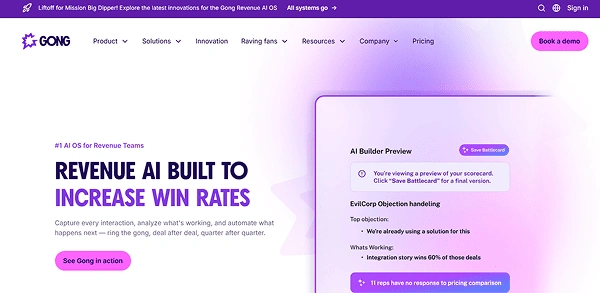
Gong is the revenue forecasting software that helps businesses to engage with their customers. It uses conversational analytics to improve sales performance review and provide reliable forecasting for Salesforce and HubSpot users. It also helps users to understand the potential risks, such as stuck deals or low engagement with decision makers, so that users can plan accordingly.
- Best for: B2B sales teams
- Pricing Details: Operates on the custom price model. Demo is available upon request.
Key Features:
- Conversational Analytics: Analyzes sales conversations across web conferences, dialers, and emails to provide valuable insights.
- AI Forecasting: Uses AI to predict the closing probabilities based on the conversational historical data.
- Performance Tracking: This system tracks both the individual and team performance metrics.
Limitations:
- Steep Learning Curve: It has complex features, search filters, and analytics that can be difficult for a new user.
8. Forecastio
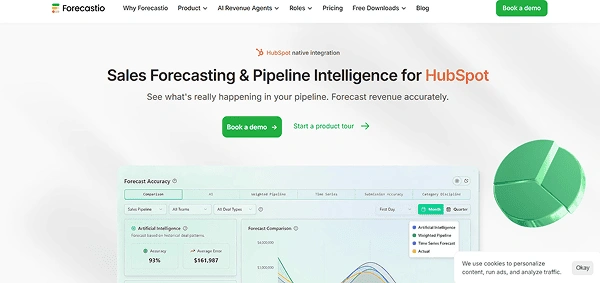
Forecastio connects to HubSpot, which is known as the best CRM for small business. It is great for the HubSpot teams that want forecasting software without buying any other expensive revenue platform.
- Best for: Sales leaders and RevOps teams using HubSpot
- Pricing Details: $249 and $369 per month, depending on the specific data needs. A free trial is available.
Key Features:
- Native HubSpot Integration: Connects directly to HubSpot CRM for real-time data updates. It automatically syncs all deals, pipelines, and forecasts without manual exports.
- What If Modeling: Allows sales leaders to analyse future scenarios and model risks. So that they can adjust their strategy for growth and understand how much the forecast depends on the uncertain opportunities.
- Pipeline Forecasting: Combines the historical data with deal amounts to calculate pipeline stage probabilities and provide close real-time forecasts.
Limitations:
- HubSpot Dependency: It is heavily dependent on HubSpot. Therefore, this platform is not suited for teams using other CRMs.
- Limited Customization: Users who have complex or enterprise-level forecasting requirements find the customization options limited.
9. Mediafly (Previously known as InsightSquared)
Mediafly is a forecasting software tool that allows users to simplify the process of sales prediction. It is a user-friendly platform to create specific reports and analyse the customer’s buying behaviour. With this, sales managers can make decisions on the basis of reliable forecasts.
- Best for: Revenue teams
- Pricing Details: Operates on a custom quote-based price model. A free trial is available on request.
Key Features:
- Revenue Intelligence: Provides AI-powered insights into the deal and pipeline progression to improve decision-making.
- Forecast Modeling: It has multiple forecast models, such as commit, best case, and pipeline, that enable scenario planning and revenue forecasting.
- Board Reporting: With pre-built board and executive-level reporting templates, it supports revenue planning and performance reporting.
Limitations:
- Feature Complexity: The extensive tooling can be too complex for the smaller sales teams that have basic requirements.
10. Spotio
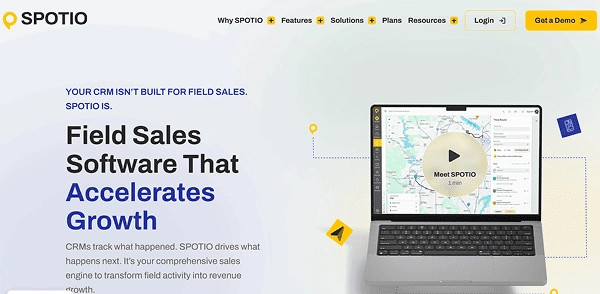
Spotio is the field sales execution platform that helps optimize many sales processes. It is focused on territory management, route planning, and reliable sales forecasting. With this, sales teams can improve their efficiency with features like real-time location and activity tracking.
- Best for: Field sales teams
- Pricing Details: Operates on a custom quote pricing model. A free demo is available.
Key Features:
- Territory Mapping: Offers visual territory planning with which managers can draw exact boundaries and restrict lead overlap.
- Field Activity Tracking: Has real-time tracking features of field sales activities that ensure accountability.
- Pipeline and Lead Management: Provides built-in tools for pipeline and opportunity tracking and lead routing.
Limitations:
- Limited to B2C Sales: It was designed for the B2C door-to-door sales. As a result, it may be less suited for B2B enterprise sales.
Next Read: 12 Best CMMS Software In 2026: Manage, Maintain, And Modernize Your Assets
Additional 10 Sales Forecast Software
Here is the extended list of 10 additional sales forecasting software. Let’s see their pricing structure and key features:
| Software | Features | Price |
| 11. LivePlan |
| Starts at $20/month with advanced features available in higher tiers. |
| 12. CashFlowFrog |
| Starts at $29/month with extensive options based on the revenue. |
| 13. Pigment |
| Custom pricing |
| 14. Scratchpad |
| Start at $24/user per month |
| 15. MaxIQ |
| Custom Pricing |
| 16. Salesloft |
| Custom Pricing |
| 17. Kluster |
| Custom pricing |
| 18. Xactly |
| Custom pricing |
| 19. Kylas |
| $250/unlimited users per month |
| 20. Revenue Grid |
| Custom pricing |
Also Explore: What is Maintenance Management Software? 5 Best Tried and Tested
Types of Sales Forecasting
There are two types of sales forecasting: quantitative forecasting and qualitative forecasting. Quantitative forecasting is found to be more reliable for businesses as it provides more accurate information.
- Quantitative Forecasting: This type of forecasting is more accurate. It is based on historical data and statistics to identify the trends and patterns.
- Qualitative Forecasting: This is a highly subjective way of making predictions. It relies on expert opinions, intuition, and market experience to frame generalised probability.
Benefits of Sales Forecasting Tools
Sales forecasting tools are highly advantageous for businesses, offering trustworthy data to improve the sales process. It also saves valuable time and leads to improved future planning.
- Trustworthy data: These platforms are found to reduce the forecast variance by 25-40%. They do the error-prone tasks like data entry and calculations to ensure that the data is accurate and consistent.
- Time efficiency: It takes hours to maintain the spreadsheets, and the sales leader might need days to run a complete forecast. This software eliminates the hard work of manual entries and predicts accurate numbers within seconds.
- Streamlined sales process: The reliable predictions help you to set realistic sales goals and improve the team’s productivity.
- Strategic Planning: The data-driven insights help in better resource allocation and management of risk factors.
How to Choose the Right Sales Forecast Tool?
To find the ideal tool it’s crucial to first set the data-driven business goals and review past sales forecasts. It is also important to check the CRM integration with the chosen software.
- Set data-driven business goals: To choose the right forecasting software, first identify your business goals. Align the software’s functionality and features with your business objective to find which software is going to work the best.
- Identify CRM needs: The forecasting system should automatically sync data directly into your CRM tool. Choose the one that can be integrated with your CRM to eliminate the manual work.
- Review past sales forecasts: Assess the past sales forecasts to know the informational gaps and identify your current requirements. This will help you find the right solution for your business.
Bottomline
Accurate sales forecasting is crucial for growing businesses as it helps in data-driven decision-making and drives enhanced revenue growth. With the best sales forecasting software like Spotio, Gong, Pipedrive, and CashFlowFrog, you can improve your revenue planning.
Select the right tool based on your specific business requirements, existing CRM, and business objectives. Also, remember that the implementation of the tool is dependent on its user friendliness, which will lead to team-wide adoption and clear processes.
FAQs
What is the best sales forecasting method?
What are the benefits of using sales forecasting software?
These platforms provide a wide range of benefits such as increased accountability and improved decision-making. They save time and enhance accuracy.
What is CRM in sales forecasting?
CRM stands for customer relationship management. In sales, CRM platforms can help manage sales and relationships more effectively with features like reporting, automation, and communication.
Can sales forecasting software integrate with my current CRM?
Most of the forecasting softwares can be integrated with the CRM tools like HubSpot, Pipedrive, and Salesforce. In this way, they eliminate the need for manual updates.
What is the best tool for forecasting sales?
Clari and Mediafly are known to be the best tools for Salesforce users. If you are using HubSpot, then Forecastio offers easy integration and functionality.