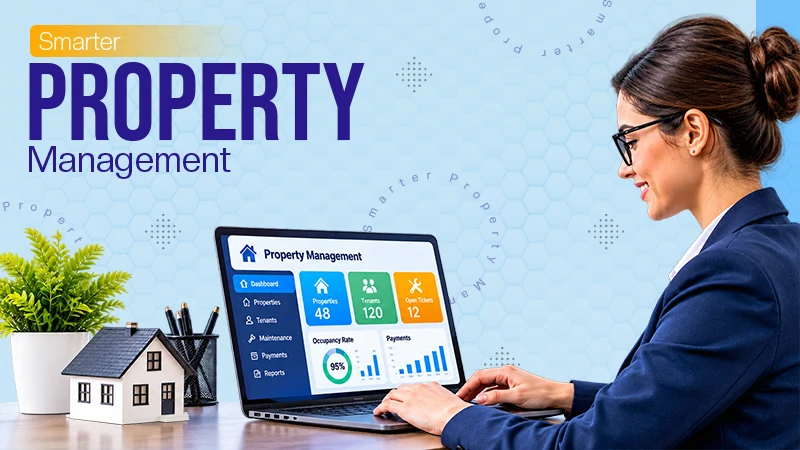
Property management software can enhance efficiency by centralizing information, reducing repetitive data entry, organizing recurring workflows, improving visibility into payments and maintenance, and supporting financial reporting.
Improve Property Management Efficiency With the Right Software
POST BY
PUBLISHED
November 2, 2026
Efficiency in property management does not mean doing the same work faster. Real efficiency means eliminating work that should not need to happen in the first place.
Small efficiencies like searching three places to find a tenant’s information, entering a payment repeatedly, maintaining requests with several calls to know the status, or an owner’s report starting with rebuilding data that already exists consume hours because they happen repeatedly.
The right property management software helps organize rental information, reducing repetitive tasks, and giving property managers a clearer view of what needs attention.
The same principles can make everyday management more organized and less dependent on spreadsheets, paperwork, and memory for landlords managing their own rentals, they are able to do so because how to choose a home laptop around the tasks they actually do.
Table of Contents:
- Property Management Efficiency Starts With Removing Rework
- Problem One: Searching for Information
- Problem Two: Entering the Same Information Again
- Rent Collection Is a Good Example
- Problem Three: Following Up on Routine Work
- Maintenance Efficiency Comes From Knowing the Status
- Problem Four: Reconstructing Information
- Communication Efficiency Is Mostly About Context
- Lease Management Has the Same Efficiency Problem
- Good Financial Visibility Reduces Guesswork
- Efficiency Does Not Mean Automating Everything
- Efficiency Should Improve as the Business Grows
- How to Judge Whether Software Will Actually Improve Efficiency
- Where SimplifyEm Fits
- A Practical Efficiency Audit
- Do Not Measure Efficiency Only by Speed
- Final Thoughts
- Frequently Asked Questions
Property Management Efficiency Starts With Removing Rework
Inefficient property management often creates one of these four problems:
- Searching: Someone has to find information before work can continue.
- Reentering: Information already recorded in one place has to be entered somewhere else.
- Following up: Someone has to manually check whether a routine task was completed.
- Reconstructing: Information from several places has to be assembled before anyone can understand what happened.
Reducing these four problems makes a bigger impact on efficiency than just trying to complete every manual work faster.
Problem One: Searching for Information
Property managers work with a large amount of information. Tenant contact details.Lease dates.Payment history.Maintenance activity.Expenses.Documents.Communication records.
When this information is spread across spreadsheets, email, paper files, and separate systems, every question begins with a search.
- Has this tenant paid?
- When does the lease expire?
- What happened with the maintenance request?
- Where is the document?
- What did the property spend last month?
To reduce the number of places someone needs to look before answering those questions, a centralized property management system is reliable. This makes information more useful because it is available when the decision needs to be made.
Problem Two: Entering the Same Information Again
Duplicate data entry is easy to overlook because each update takes only a few minutes.
A payment gets recorded in one place. Then someone updates a spreadsheet. The information may later be copied into a report.
Maintenance expenses can be entered separately into other records. These steps create substantial administrative work with repetition across a portfolio. Property management software also helps organize related records within the same environment.
The value is not simply having digital information. It is reducing the number of times people have to manually recreate that information.
Rent Collection Is a Good Example
Rent collection happens predictably every month, which makes unnecessary manual work particularly visible.
Without an organized system, property managers may need to:
• Check whether payments arrived
• Match payments to tenants
• Update payment records
• Review outstanding balances
• Send reminders
• Maintain a payment history
• Use the information later for reporting
Many property management platforms can support payment tracking, reminders, online payments, and recurring payment options, depending on the system.
These steps prevent the need to manually compare several records to understand who has paid and who needs attention because the goal is not just collecting rent electronically.
It is creating a cleaner path from rent due to rent recorded, just like the top 10 expense management software solutions in 2026.
Problem Three: Following Up on Routine Work
Property management involves constant follow-up.
- Did the tenant respond?
- Was the maintenance request assigned?
- Did the vendor complete the work?
- Was rent received?
- Did the lease renewal notice go out?
- Has the owner received the information?
Some follow-up will always require personal attention. But property managers should not have to manually check every predictable step. Software can help create more consistent processes through reminders, organized task records, payment tracking, and other workflow tools. This allows managers to focus their attention on exceptions.
To maintain a reliable form of efficiency, they can spend more time on the tenant who has not paid, the maintenance request that remains unresolved, or the property where an expense needs investigation rather than reviewing every account equally.
Maintenance Efficiency Comes From Knowing the Status
Maintenance illustrates the problem particularly well. A tenant reports a plumbing issue. The property manager contacts someone. A vendor schedules the repair. The tenant asks for an update. Someone needs to determine whether the work was completed.
If that process is scattered across calls, emails, texts, and spreadsheets, the property manager spends unnecessary time checking status. A centralized maintenance process can create a clearer record of:
• The reported issue
• The affected property
• The request date
• The person responsible
• Updates
• Repair status
• Completed work
The source article notes that centralized maintenance records improve v visibility and make it easier to prioritize repairs. The real benefit of efficiency comes from being able to see what is happening without recreating the story.
Problem Four: Reconstructing Information
This is one of the most expensive forms of administrative work because it often appears at exactly the wrong time.
An owner wants a report.
A tenant questions a balance.
A manager wants to understand property expenses.
Tax-related information needs to be reviewed.
If the underlying records have not been maintained consistently, someone has to reconstruct the history. Financial reporting becomes much easier when income, expenses, balances, and related information are organized as part of normal property management. Property management software may provide reports based on recorded data, allowing managers to review organized financial information rather than manually combining several spreadsheets.
Reports still have to be reviewed carefully for accuracy. Qualified professional guidance is required for specialized accounting and tax matters. Remember, software can improve an organization, but it can not replace financial oversight.
Communication Efficiency Is Mostly About Context
A tenant message rarely exists in isolation. A tenant asks about a repair.
To answer properly, the property manager may need to know:
- What was originally reported?
- Did someone respond?
- Was a vendor assigned?
- Has the tenant already received an update?
Without context, every message can create another search. Digital communication tools and tenant portals can help property managers keep important tenant interactions more organized. Depending on the platform, tenants may also be able to access payment information, submit maintenance requests, receive announcements, or retrieve documents.
This decreases the repetitive questions and gives the management team a clearer record of tenant activity. It makes communication that does not have to be reconstructed every time someone joins the conversation.
Lease Management Has the Same Efficiency Problem
A lease agreement may sit quietly for months. Then suddenly a date matters. A renewal is approaching. A notice may need attention. Someone needs to check a lease term. The efficiency problem is not storing the document.
It isabout aking sure important lease information remains visible when it becomes relevant.
Digital lease management makes it easier for property managers to review approaching renewals or expirations by helping organize documents and key dates. Some platforms also support document sharing and electronic signatures. Property managers should know the exact capabilities and limits of the system they are considering.
Good Financial Visibility Reduces Guesswork
Efficiency is also about making decisions with less effort instead of just considering staff time. Property managers should be able to understand basic financial questions without building a new spreadsheet every time.
- How much rent was collected?
- Which balances remain outstanding?
- What were the major property expenses?
- Are costs increasing?
- Which properties deserve closer attention?
Organized financial reporting can provide a clearer view of rental activity. That helps property managers move from gathering information to actually interpreting it. For owners, clearer reporting can also make conversations more productive because the discussion can focus on property performance rather than locating the underlying numbers.
Efficiency Does Not Mean Automating Everything
Automation works best when a task is predictable. Property management can predict a routine reminder, but can not recognize whether a tenant has a sensitive concern. Tracking an approach date is also predictable, but deciding how to handle a complicated lease situation requires judgment.
Property managers should use technology to reduce routine administrative work while retaining human control over situations that require experience, context, or discretion.
The goal should be:
Automate the predictable.
Organize the repeatable.
Surface the exceptions.
Keep judgment human.
That is a more practical definition of efficient property management.
Efficiency Should Improve as the Business Grows
An inefficient process becomes more expensive when it is repeated more often. One extra spreadsheet update may not matter. Repeated across many payments, tenants, maintenance requests, lease dates, and reports, it matters a great deal. This is why standardization becomes increasingly important as property management responsibilities expand.
Property managers benefit from having consistent ways to:
• Record payments
• Maintain tenant information
• Track maintenance
• Organize documents
• Review financial activity
• Communicate with tenants
• Prepare reports
Growth should not require inventing a new process every time another property is added. The source article makes this same point by emphasizing standardized tasks and centralized records as responsibilities increase.
How to Judge Whether Software Will Actually Improve Efficiency
Feature lists are often misleading or hard to understand. A platform can show dozens of features while still making common tasks complicated. Property managers should evaluate software based on the work they perform regularly.
Ask:
- Does it reduce searching?
Can the team find tenant, payment, lease, maintenance, and financial information quickly?
- Does it reduce duplicate entry?
Does related information remain connected, or does staff still need to update several systems?
- Does it reduce routine follow-up?
Can managers see what needs attention without manually checking every record?
- Does it reduce reconstruction?
Can reports and histories be reviewed from information already maintained in the system?
- Is it easy enough to use consistently?
Complicated software can create its own inefficiencies.
- Does it support the way the business operates?
The platform should address real operational problems rather than forcing staff to adopt unnecessary processes.
- Can it support future growth?
The same basic system should remain useful as responsibilities increase.
Where SimplifyEm Fits
When evaluating rental management technology, SimplifyEm property management software is one option property managers and landlords can consider.
The source article specifically identifies rental payment tracking, tenant record organization, expense monitoring, reporting, communication, lease management, and maintenance as areas to evaluate when determining whether the platform fits an operation.
That is the accurate way to evaluate property management technology. Always choose a software because it addresses the areas where the business currently loses the most time. Property managers should review current features, plan details, pricing, security, support, and available capabilities before making the final call.
A Practical Efficiency Audit
Before changing software, property managers can perform a simple audit of their existing operation.
For one week, pay attention whenever someone says:
“I need to find that.”
“I already entered this.”
“Let me check whether they did it.”
“I need to put this report together.”
Those statements reveal the four forms of rework. Then identify which category creates the most administrative burden.
- Searching: Information is difficult to locate.
- Reentering: The same information is maintained in multiple places.
- Following up: Routine tasks require too much checking.
- Reconstructing: Reports or histories must be assembled manually.
This provides a reliable list of problems a team has to solve before comparing software. It also makes software demonstrations much more useful because the team can test actual workflows rather than just watching a feature presentation.
Do Not Measure Efficiency Only by Speed
The fastest process is not always the best process.
- Accuracy matters.
- Security matters.
- Tenant service matters.
- Owner communication matters.
- Compliance matters.
A badly optimized and poorly automated process can make mistakes faster than a careful manual process. A good property management system helps teams work more consistently without sacrificing oversight. Efficiency should mean fewer unnecessary steps, better organized information, and other major responsibilities.
Final Thoughts
Property management efficiency is not about squeezing more tasks into every hour. It is about removing unnecessary work from the hour. Property managers should not have to search repeatedly for information that already exists. They should not have to enter the same information more than once. They should not have to manually check every predictable step.
They should not have to reconstruct a routine report from several disconnected records. A reliable property management software can help reduce those inefficiencies by providing a more organized and consistent process. That gives property managers something more valuable than faster administration. It saves more time for the work that is actually needed by a property manager.
Frequently Asked Questions
How does property management software improve efficiency?
What property management tasks can software help organize?
Depending on the platform, software supports rent tracking, tenant records, leases, maintenance, expense management, financial reporting, communication, and document organization.
What features should property managers prioritize?
Property managers should prioritize the features connected to their biggest operational bottlenecks. Major areas include rent collection, tenant records, maintenance tracking, lease management, communication, reporting, ease of use, security, and customer support.
Can property management software reduce administrative work?
Yes. It can reduce manual recordkeeping, repetitive updates, routine follow-up, and the time spent searching for data. The actual benefit depends on the platform and how effectively it is implemented.
Is property management software useful for landlords too?
Yes. Landlords managing their own rentals can benefit from more organized payment records, tenant credentials, leases, maintenance, expenses, and reporting.
How should property managers compare software?
Rather than comparing feature counts alone, property managers should test whether each platform reduces searching, duplicate entry, routine follow-up, and manual report preparation in the workflows they use most frequently.