Besides the quoted part price, consider DFM and engineering support, mold-making capability, production capacity, quality control, material expertise, secondary operations, lead times, communication, and the scope of the quotation.
How to Choose the Right Plastic Injection Molding Suppliers
POST BY
PUBLISHED
September 16, 2026
The cheapest injection molding quote is not always the lowest-cost option. A supplier that misses a tooling issue, struggles with tolerances, or lacks capacity during production can create costs that far exceed the initial price difference.
Even the U.S. Department of Energy notes that manufacturing energy use is strongly influenced by production processes and equipment efficiency.
Thus, buyers should evaluate the entire manufacturing workflow, from DFM and mold making to quality control, secondary operations, and production scalability. This guide explains the key factors to compare before moving from RFQ to tooling and repeat production.
Table of Contents:
- Define Your Project Requirements Before Comparing Suppliers
- Evaluate Engineering and Tooling Capability
- Check Production Capacity and Scalability
- Verify Quality Systems Beyond the Certificate
- Consider Secondary Operations and Supply Chain Support
- Compare Supplier Quotes on the Same Scope
- Validate the Supplier Before Full Production
- Choosing a Plastic Injection Molding Partner for Long-Term Production
- Final Thoughts
- FAQs
Define Your Project Requirements Before Comparing Suppliers
Before reaching out to plastic injection molding services suppliers, prepare enough information for each company to evaluate the same project. An incomplete RFQ can produce quotations that look comparable on price but are based on very different assumptions.
Helpful information normally includes:
- 2D drawings and 3D CAD files
- Resin or performance requirements
- Critical dimensions and tolerances
- Cosmetic requirements
- Expected order and lifetime volume
- Required secondary operations
- Assembly requirements
- Project timing
Material should also be treated as an engineering requirement rather than simply a resin name. Before the mold design is finalized, a capable injection molding partner should be able to discuss:
- Mechanical strength
- Temperature
- Chemical exposure
- Dimensional stability
- Appearance
- Processing requirements
To stay informed about project progress, consider one of the top 25 project management software options.
Evaluate Engineering and Tooling Capability
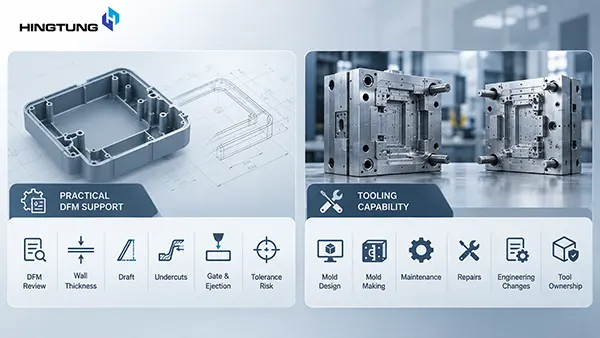
Engineering support is one of the clearest differences between basic molding vendors and competent custom plastic injection molding suppliers. The important question is not whether a supplier says it offers DFM, but what its engineers actually review before cutting steel.
Look for Practical DFM Support
A helpful DFM review should identify issues such as inconsistent wall thickness, insufficient draft, difficult undercuts, weak ribs or bosses, gate constraints, ejection risks, and tolerances that may be difficult to hold consistently. Finding these problems before tooling is often much easier than correcting them after mold trials.
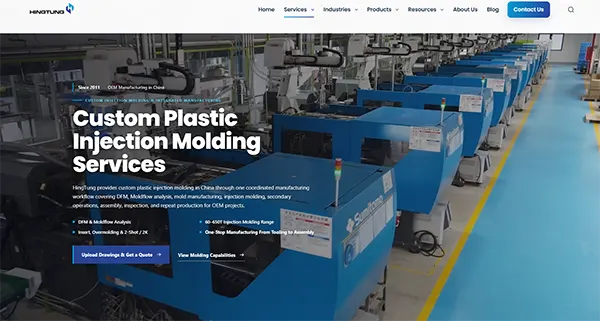
For projects where design review and tooling need close coordination, HingTung custom plastic injection molding services cover:
- DFM and Moldflow analysis
- Mold manufacturing
- Molding
- Inspection
- Secondary operations
- Assembly within one production workflow
Check Mold Making, Maintenance, and Engineering Changes
When evaluating melt-injection mold suppliers or molders that also provide tooling, ask who:
- Designs the mold
- Builds it
- Trials it
- Maintains it
- Repairs it
It is also worth confirming how engineering changes are handled and who owns the production tooling.
This counts because a supplier may perform molding in-house while outsourcing most tooling work. Outsourcing is not automatically a problem, but the customer should know where responsibility sits when a mold needs adjustment or repair.
Check Production Capacity and Scalability
Capacity should be evaluated against your project rather than by the total number of machines alone. Check whether press tonnage, shot capacity, mold dimensions, automation, and available production capacity fit the actual component and forecast volume.
For instance, HingTung operates 80+ injection molding machines ranging from 60 to 650T, supported by a 50,000 m² facility and 350+ machines and equipment. This kind of capacity data helps buyers judge whether a supplier can cover different:
- Part sizes
- Production volumes
- Future scale-up requirements
This is particularly important when comparing low-volume plastic injection molding suppliers with suppliers focused on repeat production. A company that performs well for a pilot run may not have sufficient capacity for a later ramp-up, while a high-volume plant may not be commercially suitable for smaller programs.
Verify Quality Systems Beyond the Certificate
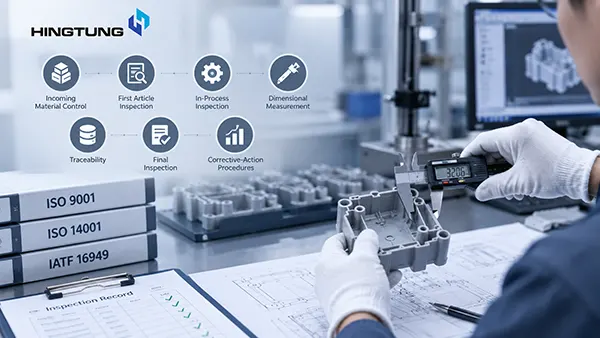
Certificates are useful when screening OEM plastic injection molding suppliers, but they should not be the only quality signal. Buyers also need to understand how the supplier controls materials, samples, dimensions, and nonconforming parts during actual production.
Pivotal points to check include:
- Incoming material control
- First article inspection
- In-process inspection
- Dimensional measurement
- Traceability where required
- Final inspection
- Corrective-action procedures
This is also where the difference between a general supplier and a precision injection molding supplier becomes clearer. Rather than treated as a marketing claim, precision should be supported by:
- Process control
- Measurement capability
- Repeatable production results
HingTung, for example, combines ISO-certified management systems with first-article, in-process, dimensional, and final inspection as part of its production workflow.
Consider Secondary Operations and Supply Chain Support
Numerous buyers searching for plastic injection molding parts suppliers need more than a molded component. Parts may require machining, printing, welding, hardware installation, assembly, inspection, or packaging before they are ready for the next production phase.
Using fewer suppliers can simplify scheduling and clarify responsibility when a dimensional or cosmetic problem arises. It can also reduce the number of tolerance handoffs between different vendors.
This is one reason buyers comparing injection molded plastic components suppliers should check which downstream operations are genuinely available within the same manufacturing workflow and which will need external subcontractors.
Compare Supplier Quotes on the Same Scope
One of the greatest difficulties when learning how to choose a custom melt-injection molding service is that two quotes may not include the same things.
Before deciding that one offer is cheaper, compare:
- Tooling scope and mold material
- Cavity count
- Expected tooling requirements
- Resin assumptions
- MOQ and production quantity
- Part price
- Inspection requirements
- Secondary operations
- Packaging
- Lead time and logistics responsibilities
Mold cost also needs context. Geometry, cavities, slides, lifters, surface requirements, tolerance, and intended production life can all change the amount of tooling work needed.
For that reason, buyers comparing custom plastic injection molding services suppliers should avoid treating the headline mold price as an independent number. A lower quote may just reflect a different tooling specification or fewer included operations.
Validate the Supplier Before Full Production
Website claims and quotations can narrow a shortlist, but samples and mold trials provide firmer evidence. Before committing to repeat production, review dimensional results, cosmetic quality, how quickly technical feedback is addressed, and whether identified problems are actually closed before the next trial.
Communication becomes extremely important at this stage. The useful question is not whether the sales team responds quickly, but whether engineering changes, quality issues, sample revisions, and production status are communicated clearly.
This validation process is helpful for buyers considering China melt-injection molding suppliers as well as domestic sources. Geography alone does not determine whether a supplier is suitable. Technical fit, process control, communication, lead time, logistics, and total project accountability still need to be compared.
Choosing a Plastic Injection Molding Partner for Long-Term Production
The strongest supplier is usually not the firm with the longest equipment list or the lowest opening quotation. A reliable injection molding partner should be able to support the project beyond the first production run, especially when these need to be coordinated over time:
- Tooling adjustments
- Repeat orders
- Quality issues
- Downstream processing
This is where an integrated manufacturing setup becomes more valuable. HingTung supports:
- DFM
- Mold making
- Injection molding
- CNC machining
- Secondary operations
- Inspection
- Assembly within the same production workflow
This makes it easier to manage changes and maintain consistency as an OEM program moves from tooling into repeat production.
Final Thoughts
Picking plastic injection molding suppliers should start with project fit rather than price alone. Define the part requirements first, then evaluate engineering support, mold control, equipment, quality systems, secondary operations, and the complete quotation coverage.
The right supplier should be able to identify manufacturing risks before tooling, prove that its production resources fit the program, and support the project when requirements are revised. HingTung combines tooling development and molding with downstream manufacturing for OEM projects, giving customers one coordinated route from DFM through stable repeat production.
FAQs
What to look for in a plastic injection molding supplier?
How can I compare injection molding supplier quotes accurately?
Make sure every supplier is quoting against the same drawings, material requirements, tolerances, cavity count, tooling specifications, production quantities, inspection requirements, secondary operations, packaging, and logistics responsibilities.
Why is DFM important when selecting an injection molding supplier?
Design for Manufacturing (DFM) helps identify potential production problems before the mold is built. A thorough review can identify issues such as insufficient draft, inconsistent wall thickness, problematic undercuts, weak ribs or bosses, gate limitations, ejection risks, and difficult tolerances.


![Patch Management Software]](https://zingmatrix.com/wp-content/uploads/2026/09/Patch-Management-Software.webp)