Ans: B2B SaaS Content Marketing refers to curating and circulating content (blogs, videos, webinars, etc) for business-to-business companies to establish themselves as a reliable partner, foster sales and real growth.
SaaS Content Marketing Decoded: A Complete Analysis that Every SaaS Founder Needs
POST BY
PUBLISHED
January 29, 2026
In a competitive B2B Market, it is profound to establish your SaaS Business as an expert and a trusted partner; it not only drives sustainable growth but also helps you stay a healthy participant for a long period.
But how can you position your venture as a SaaS paragon in a cut-throat competition?
And, that’s where SaaS Content Marketing enters the play!
You might be wondering, “What is SaaS Content Marketing? Its benefits, or how it works?”
The answer to all of these questions and other corresponding queries is comprehensively addressed in this exclusive article brought to you by Zingmatrix.
So stay tuned until the end to find out the effective solution leveraged by top SaaS companies.
Table of Contents:
Understanding B2B SaaS Content Marketing
The term “B2B SaaS Content Marketing” refers to a long-term strategic approach devised by marketers to increase leads, multiply sales, and position themselves as a reliable & legit authority.
Saas Content Strategy marketing strategy includes creating valuable, educational, and customer-centric content and leveraged to attract, convert, and retain customers for a subscription-based software product.
The key content types that are used are as follows;
- Blogs & Articles
- Ebooks & Whitepapers
- Case Studies
- Videos
- Webinars & Products
The core concept of SaaS content marketing is not unlike conventional marketing that heavily relies on one-off advertisements. SaaS content marketing emphasizes building an ongoing relationship and establishing trust.
Overall, the primary goal is to educate customers to understand their problems and how to overcome them with the SaaS product as a natural part of the solution, not the sole focus.
Do you know?
9 out of 10 SaaS businesses use blogs (long-form content over 2000 words) as they have found that they tend to outperform shorter articles and are more effective in acquiring backlinks.
Think of this content marketing as “planting a garden”.
- You need to plant seeds (create content)
- Cultivate them religiously (promote and update)
- Over time, it will grow to yield a sustainable harvest (loyal customers and recurring revenue).
B2B SaaS Content Marketing: Needs and Advantages
SaaS content marketing strategy is very crucial for SaaS ventures to thrive and for sustained growth as it offers multitudinous benefits, from nurturing leads, driving organic traffic, to building authenticity.
The unique nature of the subscription model and the B2B buyer’s journey make it an indispensable asset for enterprises.
So, without any further delay, let’s explore the amazing benefits of SaaS content promotion.
- Build Trust and Credibility: High-quality and thoughtful content cements your brand as a thought leader and a beacon of reliable resource in a tight & competitive market.
- Spurs Organic Growth: A well-mapped out content marketing strategy (effective SEO and content strategies) drives organic growth by boosting your search engine rankings, attracting a steady stream of qualified organic traffic and decreasing the need for paid advertising.
- Foster Leads: A superlative and customer-led content influences the entire sales pipeline that supports customers’ buyer’s journey that we decode in the forthcoming section in detail.
- Improve Customer Engagement and Reduce Churn: Catering to educational tutorials and updates perpetually aids users in levelling up the product’s worth, amounting to enhancing satisfaction and engagement.
- Cost-Effective: Content marketing is frugal in nature, costs less and generates 3x as many leads in contrast to conventional marketing efforts that end up offering a higher long-term ROI.
So, these are stupendous benefits of a successful SaaS content marketing and signify why it is imperative for SaaS businesses in 2026’s digital environment.
Suggested Read: 10 Best Free Music Making Software for Beginners and Pros
How to Create a Powerful SaaS Content Marketing Strategy?
The episode of engineering a robust SaaS content marketing strategy begins with a strategic, customer-centric approach that not just hard sells but educates the audience, builds reliance and features the product as the silver bullet to their problems.
So, here are the main ingredients that you need as a founder to create an effective SaaS content marketing strategy that brings leads, increases sales, and cements your product in a competitive B2B market.
Emphasize Buyer’s Journey (BOFU-First)
First and foremost, for a vigorous SaaS content marketing strategy, you are required to begin by mapping out your content to the three main stages of the buyer’s journey.
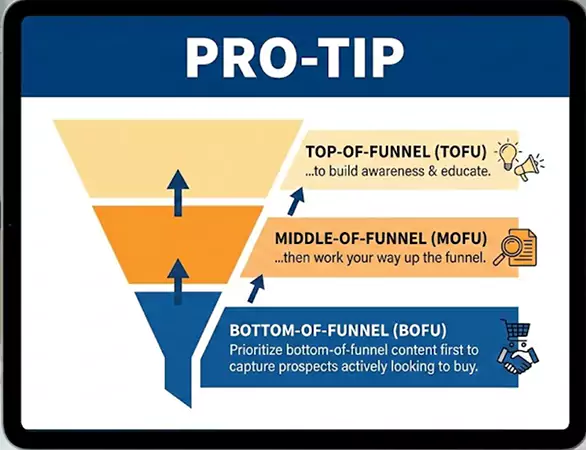
- Awareness (Top of Funnel- TOFU): The first stage of focusing buyers journey comprises educational blog posts, industry reports, and thought leadership content addressing general issues.
- Consideration (Middle of Funnel- MOFU): It is paramount to exhibit how your product tackles and solves identified problems, which implies the significance of webinars, e-books, case studies, product tutorials and integration guides.
- Decision (Bottom of Funnel- BOFU): The last and most important stage includes comparison pages ([Your Product] Vs [Competitor]), alternative pages, pricing details, and demo videos.
Furthermore, as you can contemplate the below-cited infographic, which depicts that it is highly advised to prioritise bottom-of-funnel content first to capture prospects actively wandering to buy.
Curate Superlative, Educational, and Product-Centric Content
Architect superlative content that is not just perceived as promotional content by the users, but is genuinely useful.
- Educational Content: Introduce your product as an organic part of the solution, provide step-by-step guides, how tos, and detailed resources that help users overcome specific problems.
- Long-Form Content: Extensive content works like a charm on search engines and aids in establishing authority. Therefore, it is highly advised to curate in-depth guides (2000+ words) and e-books.
- Diverse Content: Attract different preferences by fabricating various content types, including videos, webinars, podcasts, infographics, and interactive quizzes.
Utilize SEO and Topical Authority
“Organic search is the cornerstone of SaaS traffic”.
Now that you have created high-quality content, the next best thing you can do for your SaaS content is optimise your content as per search engines’ preferences, including advanced practices such as Voice Search and AI.
- Focus on keywords rich in buying intent (even if volume is lower), and a fusion of both short-tail and long-tail keywords will do the trick.
- Sort content surrounding central “pillar” pages (comprehensive write-ups on broad topics) powered by various “cluster” articles that dive into specific sub-topics. This constructs topical authority and improves rankings.
- Routinely build links to high-value content via original research, digital PR, and guest posting to skyrocket your domain authority.
- Lastly, optimize your content for conversational queries and adapt to conversational AI interactions so that your content snippets will be featured as a solution by the search engine.
Distribute and Foster Your Content
Akin to creation, the process of content distribution holds significant importance in making an effective content marketing strategy. Emphasizing this respective process ensures that your engineered content reaches the target audience and expands it.
Here are some of the best content distribution practices that will assist you in amplifying your content.
- Owned Channels: You can share your content via your email newsletter ( a highly robust channel for nurturing leads), company native website, and in-product messaging.
- Earned/Shared Channels: Repurposing content for social media platforms (LinkedIn, Instagram, X or YouTube) is a wonderful method to circulate your content. You can make sure that your IP becomes a part of industry communities (Reddit, Slack groups) and collaborating with influencers is also a proactive approach to reach masses and notch greater online visibility
- Paid Amplification: Empower top-performing content using paid ads, such as case studies or reports. These paid amplification tactics will again broaden your reach and will target specific audiences.
Get Started with Social Proof and Customer Stories
Do you know that statistics show that B2B buyers of software-as-a-service products conduct a comprehensive self-research?
Estimates indicate that 62% to 74% of buyers finalise more than half their research independently prior to engaging a sales representative. However, the big chunk of that self-research comprises customer reviews/recommendations.
Yes, over 98% of the buyers use reviews/recommendations before buying. This valuable insight implies the role and significance of social proof and how it builds trust by validating intangible products.
To build trust by showcasing real results and customer experience, you can exercise the following:
- Case Studies: You can highlight how specific clients used your software to tackle challenges and notch measurable success.
- Testimonials: Feature video testimonials and written quotes capturing legit reviews and success stories.
- User-Generated Content: Leverage social media or community forums and encourage users to share their tips and congenial experiences.
Gauge and Adapt with Data
Setting evident and measurable goals for better execution (for instance, increase qualified leads by 12-15% or elevate activation rate by 8-10%) and utilize analytics to track performance.
The key metrics that you have to monitor are organic traffic, keyword rankings, engagement rates (exit rate, bounce rate), lead conversion rates, and customer acquisition rates (CAC).
Subsequently, religiously review existing content to update statistics, incorporate novel features, enhance SEO, and ensure continued relevance. You can also hire Saas Content Marketing Agency to assist you.
Check Out: Top 10 3D Printing Software Programs with Key Features, Capabilities, Comparisons, and More!
How to Measure SaaS Content Marketing?
Measuring SaaS content marketing is necessary for businesses to comprehend the effectiveness and performance of the marketing strategy and revamp it according to it to get desired outcomes.
But how can I measure it? You may ask!
The solution lies in focusing on the “Key Performance Indicators” that directly impact business growth and revenue across the entire customer lifecycle.
Key Performance Indicators (KPIs) to track:
| Business Goals | Funnel Stage | Primary KPI | Supporting Metrics |
| Expand Pipeline | Awareness | High-Intent Content Visibility | High-intent keyword rankings, brand search volume, and organic traffic. |
| Educate Prospects | Engagement | Returning & engaged Visitors | Time on page, scroll depth, pages per session, and content downloads. |
| Generate Revenues | Conversion | MQLs/SQLs Influenced by Content | Demo requests, content-oriented conversions, and conversion rate. |
| Improve Profitability | Retention/Revenue | Content ROI | Customer Acquisition Cost, Customer Lifetime Value, Churn Rate, Monthly Recurring Revenue. |
In a nutshell, the ultimate way to calculate SaaS content marketing is to affiliate content efforts to actual business outcomes and calculate Return on Investment (ROI), instead of focusing on surface-level metrics alone.
Read Next: What is SaaS CRM, and How Does It Make Your Business Processes Faster?
The Takeaway
SaaS Content Marketing is a robust, reliable, and rewarding tool for software companies to generate leads, boost sales, and position themselves as reliable collaborators by producing valuable content.
A cluster of different types of content that not only focuses on attracting customers but also on educating and retaining them by solving their problems, reducing churn, and ushering them through the tedious sales funnel.
Therefore, if you’re someone who wants to increase brand awareness & authority, generate leads, and want customer acquisition & retention, SaaS Content Marketing is non-negotiable for you!
In this technical endeavour, there are various professional, technologically-equipped and reliable SaaS Content Marketing Agencies that will help out to engineer a robust Saas content marketing strategy.
Frequently Asked Questions
Q: What is B2B SaaS Content Marketing?
Q: What are common content types?
Ans: The common content types are Blog Posts & Articles, Webinars & Ebooks, Video Tutorials & Demos, Case Studies & Whitepapers, Email Newsletters, and Podcasts & Infographics.
Q: Explain briefly the 5 C’s of content marketing?
Ans: The 5 C’s of content marketing are as follows: Clarity, Consistency, Creativity, Customer-Centricity, and Conversion-Focused.
Q: How does content marketing for SaaS companies support longer sales cycles?
Ans: SaaS companies with longer sales cycles can use content marketing strategies, as it nurtures prospects through multi-stakeholder decisions.
Q: Do Marketers really see 6x higher conversion rates using content?
Ans: Indeed, it has been observed that marketers who leverage content experience 6x higher conversion rates than those who do not.